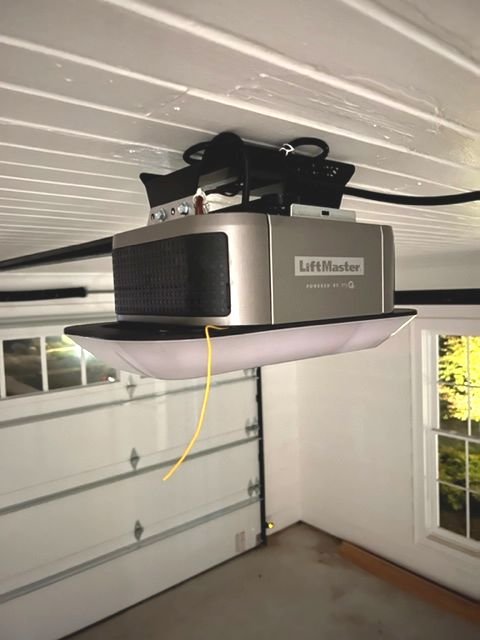
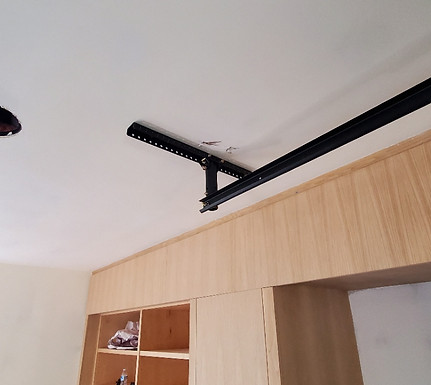
A side-by-side look at the traditional angle-iron method and a symmetrical engineered mount — and why the difference is easy to see.
Walk into a garage where the opener was hung with perforated angle iron and you can usually see it before you know what you are looking at: a web of struts, bolts and offcuts going in three directions, cut on site and fitted to whatever the ceiling gave the installer that morning.
It works. It has worked for decades. But it is improvised hardware holding up a machine that runs every day, and the difference between that and an engineered mount is visible from the doorway.
What angle iron is doing
Angle iron is stock material: an L-shaped length of steel, drilled where it needs to be drilled, bent where it needs to be bent. Its job in a garage is to bridge the gap between the ceiling structure and the opener or the door track.
Because it is stock material, the shape of the finished installation is decided by the installer's judgement on the day — how far apart the holes are, how the struts cross, how much is cut off. Two identical garages done by two good installers can look completely different, and neither is wrong.
What an engineered mount is doing
A Thunder Mounts mount is designed for one job and built in a fixed shape. The holes are where the flange needs them. The geometry is decided once, by design, and repeated on every installation. It attaches at the opener motor flanges (TMS, TMX, TML and TMMRT series) or at the overhead door track (TMGT track mount sets).
The practical differences follow from that:
- It looks intentional. Straight runs and even spacing instead of a tangle. The VSS phrase the company uses — Value, Symmetry, Safety — is really a description of what a fixed shape buys you.
- It is repeatable. A crew that installs the same mount twice gets the same result, which is what lets a dealer give a customer a realistic expectation and then meet it.
- Nothing is cut on site. The part that arrives is the part that goes up, so there is no pile of offcuts and no drilling into galvanised steel with a hand drill on a ladder.
- Four lengths, one decision. Rather than fabricating a bridge of unknown length, the installer measures and picks 12, 19, 24 or 29 inches.
What it does not change
A mount is a mounting system. It is not sold with an opener or a door attached, and it does not replace the manufacturer's load ratings or the need to fix into structure rather than into drywall. Any installer fitting one should still be following the opener manufacturer's instructions for the ceiling attachment.
Seeing the difference
The clearest way to judge it is side by side, from the same angle, in the same garage. Once you have seen a symmetrical install next to an angle-iron one, the question stops being about aesthetics and becomes about which one you would rather explain to a customer.